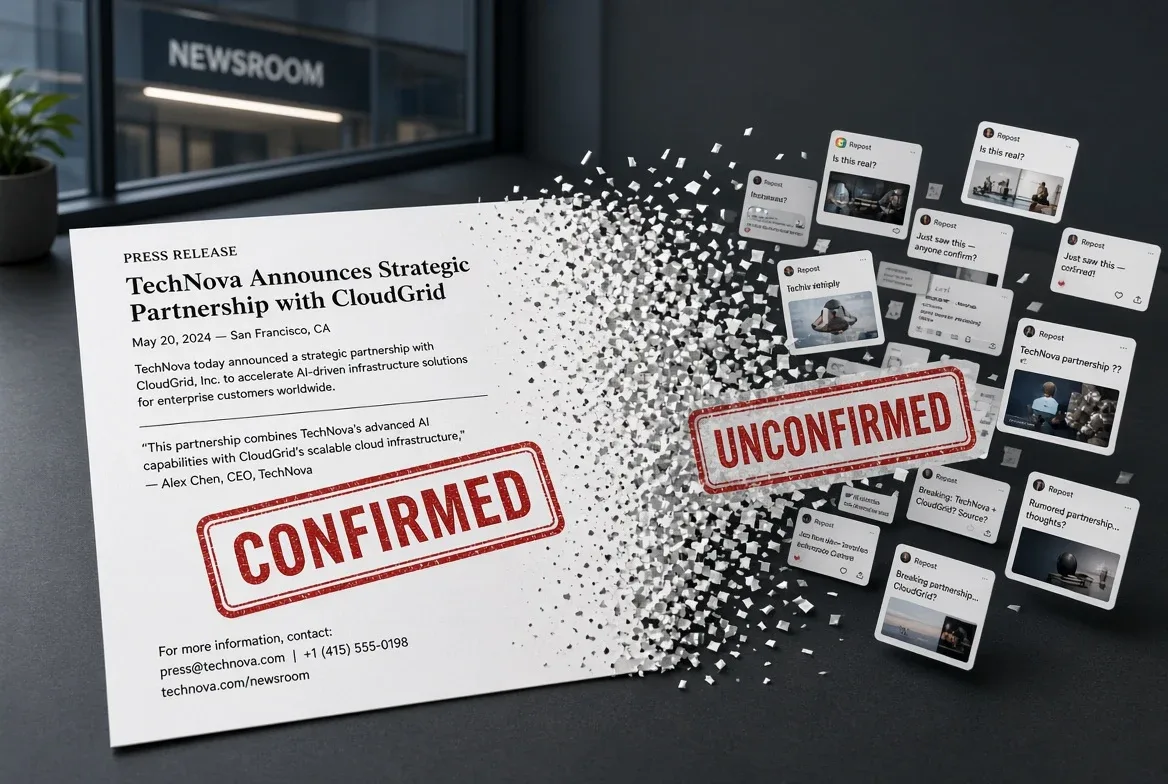
A real company announcement always leaves a trail on a channel the company controls: a regulatory filing, its own newsroom, or a named outlet that traced it back to one. If a viral claim has none of those, it is unconfirmed. That is the whole test.
The rest of this guide is the order in which to run it, and the two cases that show what happens when nobody does.
What counts as confirmation of a corporate claim?
Three things: a filing in the SEC's EDGAR database, a statement on the company's own newsroom or investor-relations page, or a named outlet that credits one of those. Anything else — a screenshot, a repost, a headline quoting a headline — is unconfirmed until it lands on one of them.
The SEC's filing search covers company name, ticker and CIK, plus a full-text tool spanning "more than 20 years of EDGAR filings," and it publishes submissions "as they are submitted into the EDGAR system," per the SEC's own search-filings page. So a genuine material announcement is usually checkable within minutes, by anyone, for free.
Absence is informative. If a company supposedly announced a partnership this morning and its newsroom says nothing, the correct label is not "not yet reported." It is unconfirmed.
Where did the fake Walmart-Litecoin release actually come from?
The claim started as a press release distributed through the wire service GlobeNewswire on Monday, Sept. 13, 2021, stating that Walmart would begin accepting Litecoin payments on Oct. 1. It was false. Walmart said so the same day.
In a statement posted to its corporate newsroom, the company said it "had no knowledge of the press release issued by GlobeNewswire, and it is incorrect," adding that "Walmart has no relationship with Litecoin." GlobeNewswire issued a notice telling readers to disregard the release.
The market moved before any of that. Newsweek reported that Litecoin jumped more than 36 percent in under an hour, from about $174 to $237 on Coinbase, before falling back toward $180, and that the fake release carried a fabricated quote attributed to Walmart's chief executive. Several outlets, including CNBC and Yahoo News, republished the claim.
The origin trail was available the entire time. The release named a company; that company had a newsroom; the newsroom said nothing until it said the opposite.
Can a fake filing really appear on EDGAR?
Yes, and it has. A regulatory database is not a lie detector — it records what a filer submits. The check that matters is whether the company itself has confirmed the filing's substance.
In an announcement dated June 4, 2015, the SEC said a false tender offer for Avon Products had been filed on EDGAR in May 2015 from an IP address in Sofia, Bulgaria, and charged Bulgarian trader Nedko Nedev and four entities, including PTG Capital Partners, over the scheme. Avon's stock rose 20 percent on May 14, 2015, according to the same announcement.
The SEC said Nedev made roughly $5,000 in excess profits and that it froze about $2 million in two brokerage accounts. Enforcement director Andrew Ceresney said the emergency order "keeps not only the alleged illicit profits from being transferred offshore, but preserves the SEC's ability to recover substantial penalties." The agency described similar schemes involving Tower Group International in 2014 and Rocky Mountain Chocolate Factory in 2012. These are the SEC's allegations.
What checks should you run, and in what order?
Four, and they take about five minutes. The order matters, because each one narrows what the next has to explain.
- Go to the company's own newsroom or investor-relations page. A real announcement of this size lives there. A blank page is a red flag, not a delay.
- Search EDGAR by company name or ticker. Material corporate events generally leave a filing, and EDGAR shows submissions as they arrive.
- Find the original, not the retelling. Track the claim to the first named outlet or the original post. If every version cites another version, the trail has no bottom.
- Check the wire service. Distributors publish withdrawal notices when a release is fraudulent, as GlobeNewswire did in 2021.
If all four come back empty, the honest description is that an unverified claim is circulating, with its origin named — not that something is "reportedly" happening.
Why do fake business announcements spread so fast?
Because impersonating a company is cheap and the payoff is immediate. Consumers reported $1.1 billion in combined losses to government and business impersonation scams in 2023, more than triple the 2020 figure, according to the FTC.
The agency's rule on government and business impersonation took effect on April 1, 2024, giving the FTC stronger tools to seek money back and civil penalties in federal court. The FTC said bank transfers accounted for about 40 percent of reported losses to those impersonators in 2023, followed by cryptocurrency at 21 percent.
What if the "proof" arrives as an official-looking document?
Treat the document as a claim, not as evidence. The SEC's updated investor alert on fake Form 4 filings, dated March 15, 2024, describes fraudsters sending forged filings to convince victims that shares were bought or held for them.
Two facts from that alert settle most of these cases. Form 4 filings "are not confirmations of purchases or transfers of shares," and any email claiming to be the SEC confirming a specific trade is fraudulent. The alert tells investors to check EDGAR's ownership disclosures directly, to verify a financial professional's registration through Investor.gov, and to call the SEC to confirm whether a message is genuine.
Claim versus evidence
| Claim | Origin | Evidence | Status |
|---|---|---|---|
| Walmart will accept Litecoin from Oct. 1, 2021 | Press release on GlobeNewswire, Sept. 13, 2021 | Walmart newsroom statement: no knowledge of the release, no relationship with Litecoin | False |
| A buyer had made a tender offer for Avon Products | EDGAR filing, May 2015, from an IP address in Sofia, Bulgaria | SEC announcement of June 4, 2015 charging Nedko Nedev and four entities over a false filing | False, per the SEC's allegations |
Both claims moved prices before either was checked. Both were checkable in minutes.
For a related trending perspective, read Trace a viral photo's origin with reverse image search.