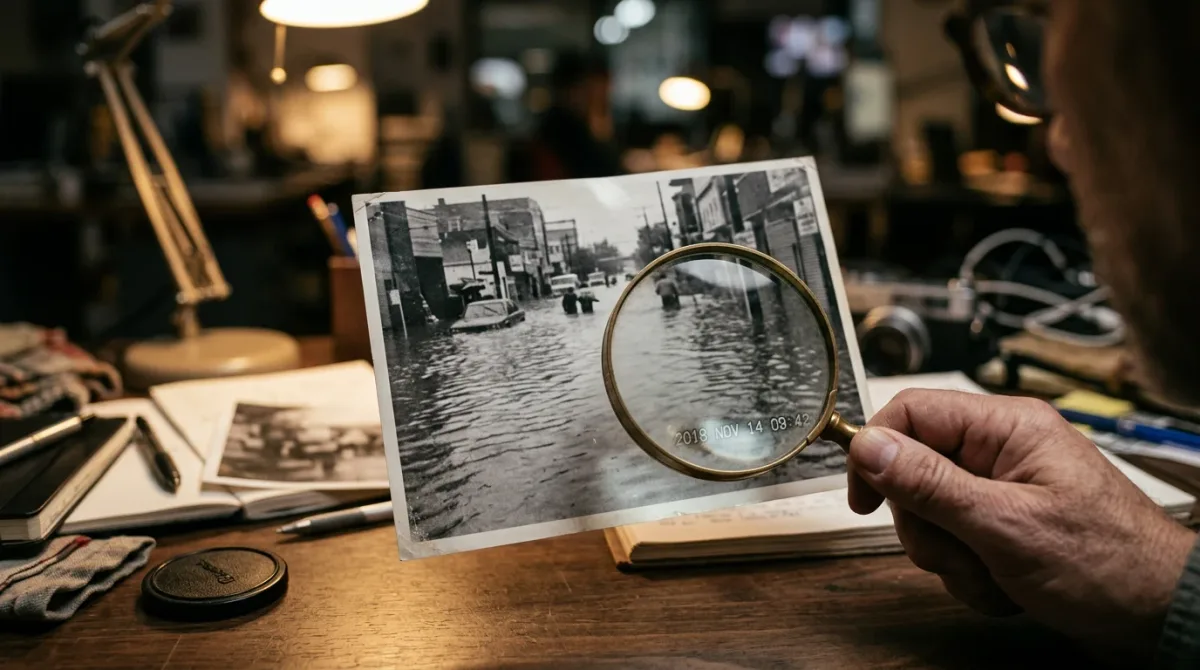
A reverse image search can trace almost any recycled photo back to its first appearance online — that method is taught by university library-science guides, including one from Princeton, specifically for this kind of viral debunking. It doesn't require special software. The tool is already built into the search engine most people have open anyway.
The clearest test case is the "street shark" — a shark appearing to swim down a flooded highway, shared as proof of whatever storm is in the news that week. It is not real, and it is not new. CBS News reported on October 11, 2024, that the image "has reappeared during multiple hurricanes since" at least 2011, recycled every storm season regardless of which hurricane is actually making headlines.
Where did the "street shark" photo actually come from?
It's a fabricated composite, not a photograph from any specific storm. CBS News's reporting places its first known circulation around 2011 and describes it resurfacing "during multiple hurricanes since," attached each time to whatever storm is trending.
CBS grouped it with a broader pattern of hurricane misinformation: unverified crime reports (like tire-slashing rumors after Hurricane Helene), government-conspiracy claims that racked up "more than 160 million views online after Helene," fabricated or AI-generated visuals — including an image of Walt Disney World flooding during Hurricane Milton that never happened — and post-disaster scams targeting storm victims.
The shark photo sits in that visuals category. Its staying power isn't cleverness. It's that each new storm hands it a fresh audience that hasn't seen it debunked before.
What tool actually finds an image's original source?
Reverse image search — Google's built-in Lens tool, or a dedicated tracker like TinEye — is the method both library guides point to, and neither requires an account or a download.
The Princeton University Library guide lays out the Google Lens process directly: save or copy the image, click the camera icon in Google's search bar, upload the file or paste its URL, then review the results. The guide highlights three tabs worth checking — Visual Matches, Exact Matches, and "About this image" — and notes that adjusting the crop around the photo's focal point, tighter or wider, changes what the search surfaces.
Washington State University Libraries recommends the same camera-icon search in Google Images, plus TinEye specifically, which the guide says is built for tracking "how and how often an image is being (or has been) used online." TinEye sorts matches by Best Match, Most Changed, Newest, and Oldest — a sort order built for exactly this kind of tracing.
How do you read the results without getting fooled again?
Sort by oldest match, not most recent. The earliest indexed appearance of a photo sits closer to its real origin than however many accounts have reposted it since.
Both library guides frame the goal the same way: find where and when an image first appeared, not where it's being shared right now. Princeton's guide specifically calls out the "About this image" panel in Google Lens as the place to check whether "credible outlets are reporting that an image was manipulated" — meaning a fact-check may already exist, attached to the same photo, before you go looking for one yourself.
A caption swap is also a giveaway. If the same photo shows up years apart, each time labeled with a different storm, city, or disaster, that alone is closer to proof than any visual detail in the image itself.
Why does the same fake photo come back every year?
Because it never stays debunked in the feed where it resurfaces — the fact-check from the last storm doesn't travel with the photo to the next one.
CBS News's reporting frames this as a pattern, not a one-off: fake visuals are one of four recurring hurricane-misinformation categories the outlet tracks each storm season, alongside unverified crime claims, conspiracy theories, and post-disaster scams. The shark photo is simply the most durable example — recognizable enough to spread fast, vague enough to attach to any flood.
The fix doesn't change from storm to storm either. Before sharing a dramatic disaster photo, run it through Google Lens or TinEye and check the oldest match first. If that oldest result predates the current headline by years, the claim attached to it is false — confirmed by the search results themselves, not by trusting the caption.
For a related trending perspective, read Trace a viral photo's origin with reverse image search.