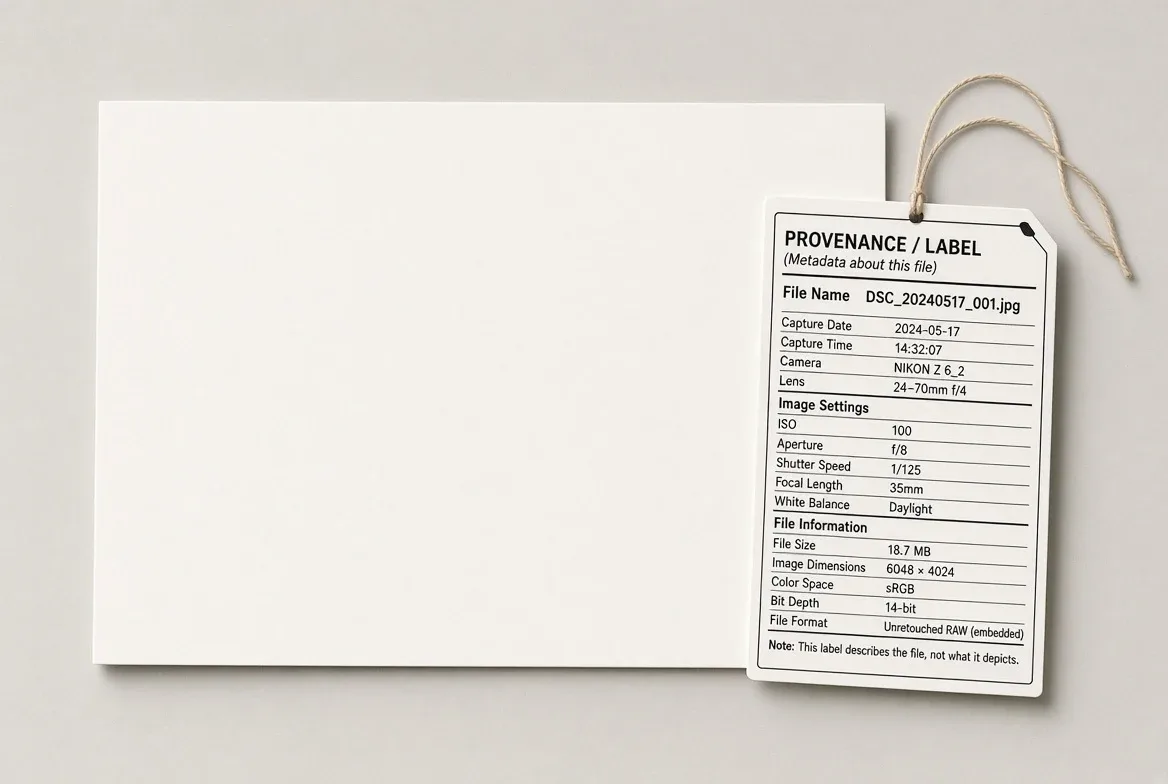
Confirmed: a Content Credential proves who signed a file and what that signer recorded about its origin and edits. It does not prove the picture is true. That gap — between a signed history and a verified fact — is the most misread part of the standard.
The label is spreading fast across camera apps, AI image tools and social platforms. Here is what it confirms, what it leaves unconfirmed, and how to use it on a viral image without over-reading it.
What is a Content Credential, exactly?
It is tamper-evident data attached to a file, built to an open standard from the Coalition for Content Provenance and Authenticity. C2PA describes its work as "an open technical standard for publishers, creators and consumers to establish the origin and edits of digital content," and calls Content Credentials "a nutrition label for digital content."
That nutrition-label framing is the useful one. A label lists what the manufacturer declares. It does not independently taste the food.
Technically, the credential travels as a signed manifest. The Content Authenticity Initiative's open-source documentation describes tooling that lets developers "read, validate, create, and sign manifest data, and embed it in supported asset files." A viewer checking that file can confirm the signature is intact and that the recorded history has not been altered since signing.
The small "Cr" pin you see in corners of images is the surface of that system. The same documentation says the mark exists "to provide a consistent user experience and set expectations that an application, tool, or website implements C2PA standards." The pin is an invitation to inspect, not a verdict.
Who is behind the standard?
C2PA lists its steering committee publicly: Adobe, Amazon, BBC, Google, Meta, Microsoft, OpenAI, Publicis Groupe, Sony, TikTok and Truepic. That membership is confirmed on the coalition's own site, and it explains why the label now appears in places most readers encounter daily — phone cameras, generative image tools, and platform feeds.
Membership matters for a specific reason. A credential is only as meaningful as the identity attached to the signature. A manifest signed by a named news organization's camera-to-publication pipeline carries different weight than one signed by an unknown key.
So the practical question is never "does this image have a Content Credential?" It is "who signed it, and do you have reason to trust that signer?" The standard is designed to let you ask that question. It does not answer it for you.
Where does it break?
The most authoritative account of the limits is federal. In NIST AI 100-4, "Reducing Risks Posed by Synthetic Content," published in November 2024, the National Institute of Standards and Technology sets out how provenance data tracking fails in the wild.
The first failure is deletion. NIST states that "metadata recorded within a file can similarly be stripped altogether, as it often is when files are shared (e.g., via social media platforms)." A screenshot, a re-upload, or a re-encode can leave a genuine image with no credential at all.
The second failure is accuracy. NIST is blunt: "It is also difficult to make sure recorded metadata is accurate; this is typically not verifiable even by cryptographic means." A signature proves nobody changed the record. It does not prove the record was honest when it was written.
NIST reports the same fragility in watermarking, the sibling technique. It notes that "a dedicated AI system can be trained using a dataset of watermarked images to strip out the watermark," and that spoofing attacks have been measured "reducing detector performance by around 5-20% depending on the watermarking method." Its overall conclusion: "None of these techniques offer comprehensive solutions on their own."
How do you check a viral image yourself?
Start by treating provenance as one input among several. In the September 2023 joint advisory "Contextualizing Deepfake Threats to Organizations," the NSA, FBI and CISA draw the line clearly: "detection methods are often passive forensic techniques, whereas authentication methods are active forensic techniques that are purposely embedded at the time of capture or time of edit."
A Content Credential is the second kind. It has to be added deliberately, in advance, by whoever made the file. Its absence tells you almost nothing, because most files never had one.
The same advisory recommends unglamorous first steps that still work: "Make a copy of the media prior to any analysis," hash the original and the copy to confirm the copy is exact, and run "Reverse image searches, like TinEye, Google Image Search, and Bing Visual Search." Reverse search is what actually finds the earliest posting of a viral image, which is the fact that usually settles the argument.
If a credential is present, inspect it rather than trusting the pin. The Content Authenticity Initiative's open-source tooling can "Display a report of JSON manifest data attached to an asset," which is the level of detail the icon compresses away.
Claim versus evidence
| Claim | What the sourced evidence shows |
|---|---|
| A Content Credential means the image is real and unedited. | False. C2PA defines the standard as establishing "the origin and edits" of content — edits are recorded, not prohibited, and truth is not assessed. |
| No credential means the image is probably AI-generated. | False. NIST states metadata "can similarly be stripped altogether, as it often is when files are shared." |
| Cryptographic signing makes the recorded history trustworthy. | Unconfirmed at best. NIST: metadata accuracy "is typically not verifiable even by cryptographic means." |
The honest summary is narrow and useful. A verified Content Credential confirms an unbroken chain from a named signer. Everything past that — whether the signer is trustworthy, whether the scene happened — is still ordinary reporting work.
For a related social perspective, read Reverse image search, explained: what it can actually prove.
For more context, read How to trace a viral claim to its original source.