Social security retirement benefits are calculated from one thing above all: your own earnings history. The program looks at the years you worked and paid into it, averages your highest-earning years after adjusting them for wage growth, and then applies a formula that replaces a bigger share of low lifetime earnings than of high ones. The result is a monthly amount, and the age at which you claim it moves that amount up or down.
That is the whole skeleton. Everything else — the debates, the annual cost-of-living increases, the claims about when to file — hangs off those three steps: the earnings record, the averaging, and the progressive replacement formula. Here is what each one does, and where the common misunderstandings live.
What actually goes into the record?
Only work covered by the program counts. Wages from jobs where you paid social security taxes, and self-employment income reported on your tax filings, build up your record year by year. Years you did not work — or worked off the books — simply leave gaps. The formula is built to tolerate some gaps, but a career with many blank years averages out lower than one with steady covered work.
You can check your own record rather than guess at it. The Social Security Administration keeps your earnings history and posts your estimated benefit on your account; you can review it through the agency's sign-in page. Checking matters because the record is the raw input for everything downstream, and errors in it are fixable — but only if someone catches them.
How does the averaging work?
The calculation does not use your final salary, and it does not use every year you ever worked. It takes a span of years, adjusts earlier earnings upward so they are comparable with later ones — a step called indexing, which accounts for the fact that a dollar earned decades ago bought more relative to wages at the time — and then averages the highest-earning years within that span.
The practical effect: a handful of very high-earning years can lift the average, and a stretch of low-earning or zero-earning years can drag it down. This is why the same salary history produces different results depending on how much of a career was covered. Someone who worked covered jobs for most of a working life has less averaging risk than someone whose record is thin.
Why is the formula called progressive?
Once the average is set, the formula replaces different slices of it at different rates. The first slice of your average earnings is replaced at the most generous rate. The next slice is replaced at a lower rate, and any remaining slice at a lower rate still. The slices themselves are set by income thresholds that the program adjusts over time.
What this means in plain terms: two people do not lose the same share of their average earnings when they stop working. A worker with modest lifetime earnings gets a larger fraction of that average back each month than a high earner does, though the high earner still receives a larger check in dollars. This is a deliberate design choice, not an accident, and it is the single most misunderstood part of the system. People often assume the benefit is a flat percentage of salary. It never was.
How does claiming age change the check?
The amount the formula produces is not necessarily the amount that lands in your bank account. Each person has a full retirement age — the point at which the calculated benefit is paid in full. Claiming earlier than that permanently reduces the monthly amount. Delaying past it, up to a late-age cutoff, permanently increases it. The adjustments are actuarial: roughly speaking, they are designed so that a shorter collection period balances against a larger monthly check, and a longer collection period against a smaller one.
There is no single right age to claim. The arithmetic rewards waiting; the reality of health, savings and employment often does not. What the calculation guarantees is only the trade-off itself — a smaller check for longer, or a larger one for shorter. Anyone telling you one age is universally correct is skipping over the part of the formula that depends on how long you actually collect.
What happens to the check after you claim?
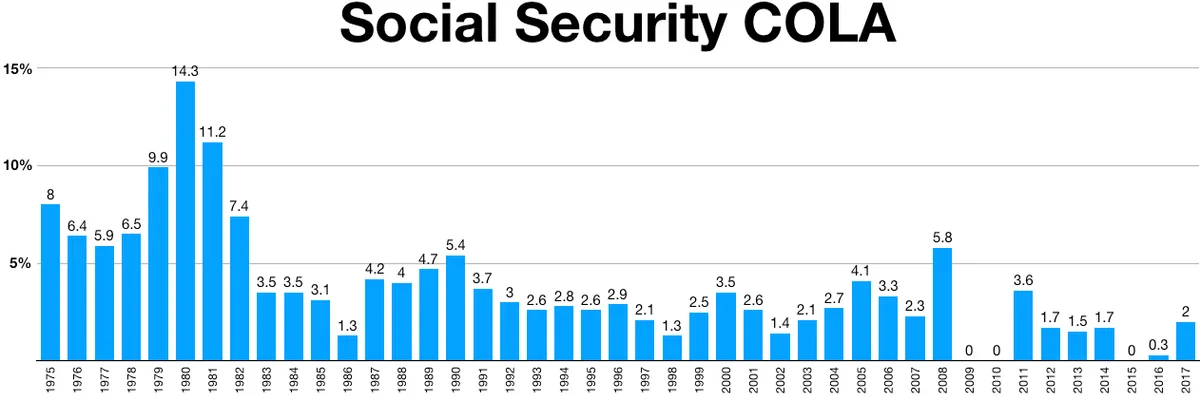
Benefits are not frozen at the amount you first receive. Each year, the program applies a cost-of-living adjustment, or COLA, tied to inflation, so the check is meant to hold its purchasing power rather than erode. We have a separate piece on how the yearly COLA is set, including the index it comes from and why some years produce a bump and others produce almost nothing. For related coverage, see Social Security COLA explained: how the yearly increase is set.
One caution belongs here. Because the program touches nearly every retiree, it is a constant target for viral misinformation — fake changes to eligibility, invented benefit amounts, scare posts built to farm shares. The verification habits we cover in our social coverage apply here as much as anywhere: trace the claim to an original named source before repeating it. The Social Security Administration's own site is the primary source for nearly every factual claim about the formula. We covered a connected angle in Deleted Viral Posts: Archiving and the Evidence They Leave Behind.
Our analysis: where the formula's reputation outruns its reality
The formula is often described as opaque, and the indexing math genuinely is dense. But the structure is not mysterious: an average of your best covered years, replaced at a shrinking rate slice by slice, adjusted by when you claim and by inflation after that. Most confusion comes from people importing assumptions from other retirement systems — a flat pension rate, a final-salary calculation — that this program never used.
What the evidence supports is a system that rewards a long, steady covered work history more than a short, high-earning one, and that leaves the claiming-age decision as a genuine trade-off rather than a solved problem. What remains unknown to any individual reader is their own record's accuracy and their own claiming horizon. Both are personal. The first is checkable. The second is not a math problem at all.