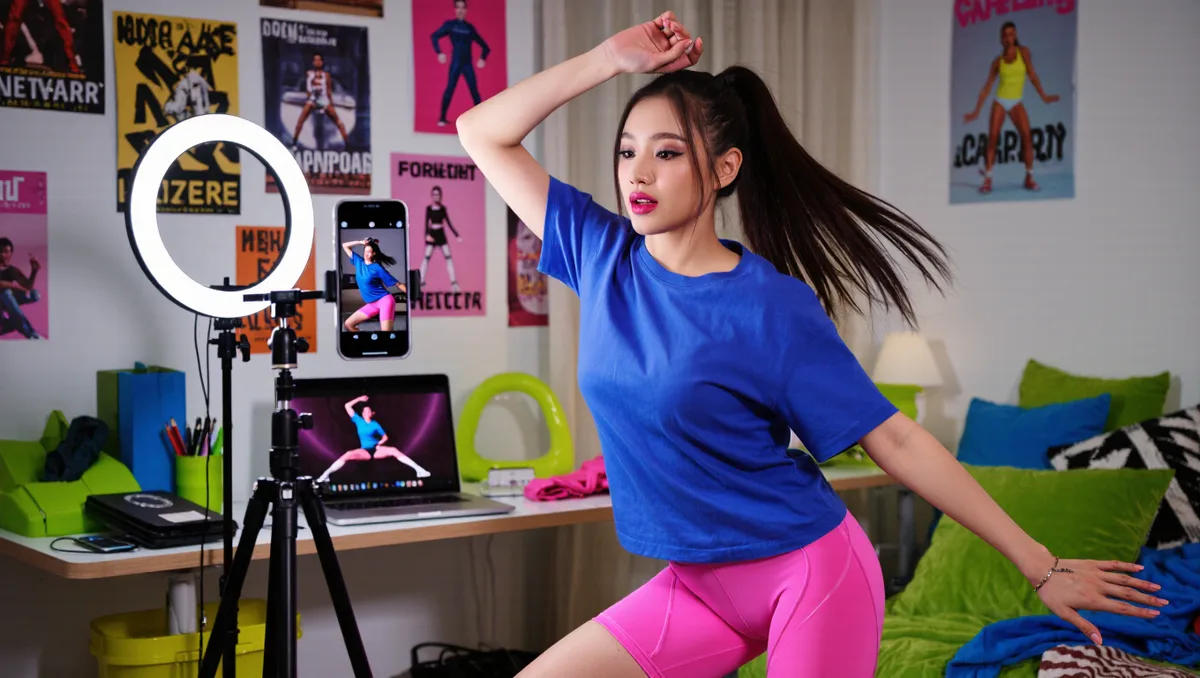
The verdict up front: most viral TikTok dances are easier than they look, a handful are genuinely hard, and the difference comes down to three things — how many moves the routine has, how fast the music moves, and whether the choreography needs real dance training. This ranking sorts the routines people actually copy into three tiers, from one-take beginners to the ones that take weeks of practice.
One note on the word itself. "Viral" started in medicine: a virus spreads by making copies of itself inside the body's cells, as the Cleveland Clinic explains in its overview of viral infection. A dance trend borrows that pattern — one routine, thousands of copies, each one slightly changed. That copying loop is also why difficulty spreads unevenly: the easier the routine, the more copies it gets.
Here is the tier-by-tier ranking, built on what the choreography actually asks of your body.
What makes a viral TikTok dance easy or hard?
Three factors decide it. First, move count: routines built on four to eight repeated moves are learnable in minutes; routines with long, unbroken sequences are not. Second, tempo: a slow song gives you time to think between moves, a fast one does not. Third, technique: steps that need hip isolation, fast footwork or controlled body rolls demand training that arm waves and simple side-steps do not.
There is a fourth factor that gets overlooked: the camera. Many routines are choreographed to look good in a fixed framing, which means the hard part is sometimes hitting a mark, not hitting a beat. That is good news for beginners — staging can be learned faster than technique.
Tier one: the beginner-friendly routines
These are the dances that made the format famous. The structure is simple: a short sequence of arm movements, a step-touch or two, and a clear moment that syncs to a lyric or a beat drop. Most people can learn one in under an hour by watching the original a few times.
The tells of a tier-one routine:
- Moves repeat, so you only need to memorize a small sequence.
- Everything happens above the waist or as simple steps — no floor work.
- The camera does most of the work; a static phone shot at chest height is enough.
If you have never learned choreography before, start here. The point of these routines is participation, not precision. A slightly messy copy that hits the signature move on the beat will read as a successful attempt.
Tier two: the middle ground
This tier is where most dance trends now live. The routines borrow real dance vocabulary — a groove, a body roll, a quick direction change — but keep the sequence short. Expect an evening or two of practice, and expect the first few attempts to look stiff.
What separates tier two from tier one is isolation. Moving your shoulders while your hips stay still, or stepping on the off-beat, requires your brain to split attention between body parts. That is a learnable skill, but it is the first wall beginners hit. Slowing the video to half speed and drilling the hardest four-count is the standard fix, and it works.
It is also the tier where the original choreographer matters most. The routine's difficulty is fixed by whoever made it, and how trends travel from an original upload to mass copies is its own story — we break that down in How viral dance trends actually get made.
Tier three: the genuinely hard ones
These are routines that demand actual training: fast, precise footwork; jumps landed on counts; floor work; or sequences long enough that memorization alone is a project. Dancers with years of classes still rehearse these before filming. If a routine makes trained dancers count it out loud, it is not a beginner dance, whatever the caption says.
The honest advice for tier three is to treat it as a project, not a copy. Learn it in eight-count sections. Film yourself from the same angle as the original — the gap between what you think you are doing and what the camera sees is the real teacher. And accept that some routines reward a background you do not have yet; that is fine. Difficulty is information, not a gate.
Our analysis: why difficulty shapes which dances spread
Our analysis of the format's history points to a simple pattern: the dances that reach the widest audience are the ones calibrated to tier one or low tier two. A routine that is too hard gets impressive views but few copies, and copies are what push a trend through feeds. The choreographers who go viral repeatedly tend to be the ones who design a signature move that is easy to land and hard to forget.
That also explains the copy-with-a-twist cycle. Once a routine saturates, users escalate it — faster, funnier, harder — which briefly revives it at a higher difficulty tier. The trend's life cycle runs from easy original to hard remixes until the next easy original arrives. For more on the mechanics behind that spread, see Why some videos explode and others flop.
Practical steps: picking the right tier for you
- Watch the original once and count the distinct moves. Under eight, start there.
- Check the tempo. If you cannot nod your head to the beat comfortably, the routine will feel twice as hard.
- Look at the feet. Footwork-heavy choreography is tier three almost always.
- Slow the tutorial to half speed and learn one eight-count at a time.
- Film your attempt at the same angle as the original before you post.
The broader takeaway: a viral TikTok dance is a piece of choreography designed to be copied, and its difficulty is a design choice, not an accident. Pick the tier that matches your practice budget, credit the choreographer when you post, and remember that the routine you learn fastest is usually the one built to be learned fast.