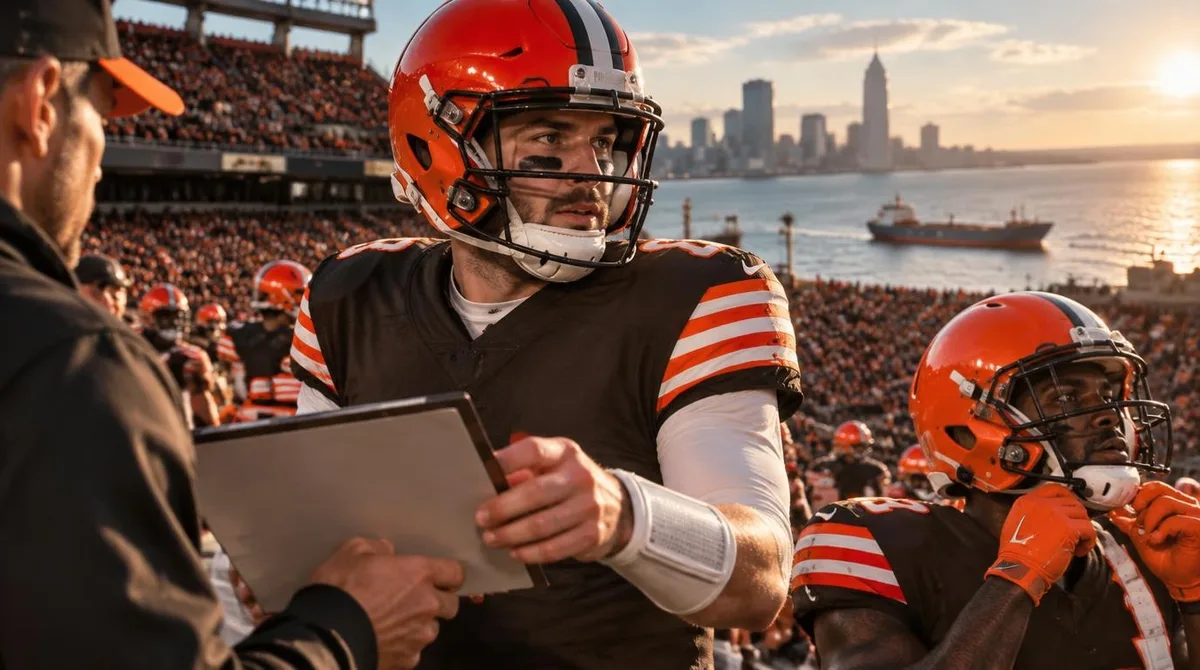
The confirmed part is small and specific. According to Yahoo Sports, Cleveland Browns quarterback Deshaun Watson exited briefly against the Steelers and was replaced by Shedeur Sanders. That is what the reporting supports. The rest — what the viral video actually shows and what it means — is unconfirmed.
Yahoo's headline says the video "isn't what it seems." The retrieved text does not include the article's full explanation of why. So the honest ledger reads: the clip exists, the swap happened, and the interpretation is still open. That gap between a clip and its meaning is where most sports misinformation lives.
This is a pattern readers of viral coverage will recognize. A few seconds of sideline footage gets stripped of its context. Then the caption does the arguing. The footage may be real while the claim attached to it is not.
What is actually confirmed about the Browns clip?
Two things. First, per Yahoo Sports, Watson left the game against the Steelers for a short stretch. Second, Sanders came on in his place. Getty is credited for the photo of the swap. Those are the load-bearing facts, and they come from a named outlet, not an anonymous account.
What is not confirmed: the video's supposed meaning. Yahoo's own headline flags the mismatch, but the full reasoning behind that flag is not in the material available here. Treat any strong interpretation of the clip — who was upset, why, what it signals — as unconfirmed until the reporting spells it out.
Why do sports clips spread faster than the facts about them?
A clip travels on its own. The context travels separately, if at all. Sideline footage is ideal raw material because it is ambiguous by design: a camera catches a reaction, and every viewer fills in the motive. The reaction is real. The motive is a guess.
That is the same engine behind old clips resold as breaking news. The footage authenticates itself — "look, it's right there" — while the framing around it goes unchecked. In a quarterback controversy, the framing writes itself: a backup appears, and suddenly the clip means a depth-chart drama.
How should you read a clip like this one?
Slow down at the caption. Ask what the footage independently proves and what only the caption asserts. A short guide to the habit is in how to trace a viral claim to its original source: find the first upload, check who posted it, and see whether any named outlet confirms the interpretation.
With this Browns clip, the traceable origin is the Yahoo Sports piece itself. That is a reporting source, not a random repost, which is a good sign. But a headline flagging "isn't what it seems" is a promise the article body has to keep — and until you read that body in full, the safest verdict is unconfirmed.
What does this mean for Sanders and the Browns?
Only this: he took game snaps when Watson exited briefly against the Steelers. Any larger claim — about the depth chart, the coaching staff's plans, or a rift — is not supported by the material here. Watch for named reporting before accepting any of it.
The likely next development is straightforward. Either follow-up reporting explains what the video actually captured, or the clip fades once no outlet confirms the dramatic version. Both outcomes are common. The dramatic version is the one that spreads first, which is exactly why it should be the one you trust least.
The discipline that helps: separate the footage from the story. The footage here is confirmed. The story is still open, and engagement bait thrives in exactly that gap.