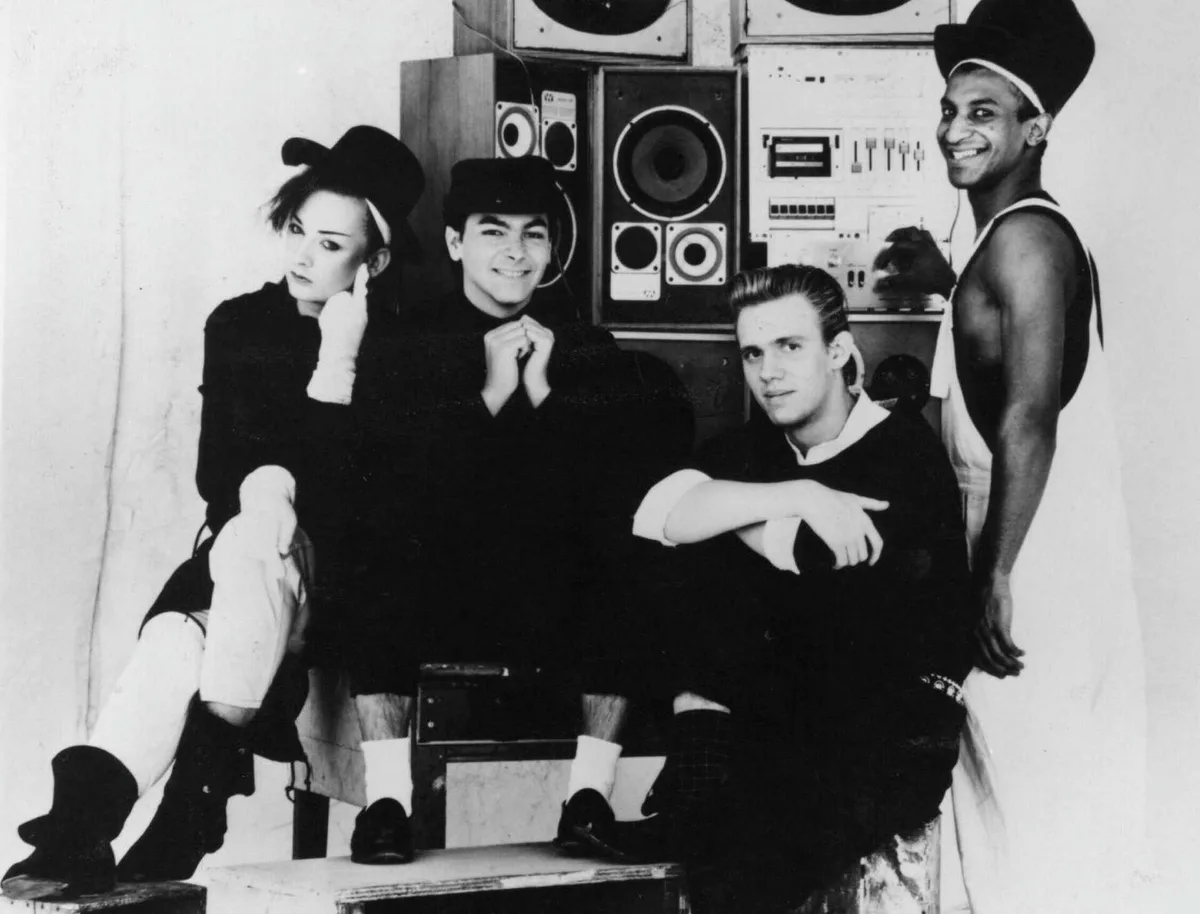
Culture Club changed pop by treating the image as part of the music, not a wrapper around it. The band's look — its clothes, its colors, its open refusal of the era's rock-star uniform — was the act. The songs carried it, but the picture did half the work.
That idea now feels ordinary. Every pop act today arrives with a visual world: a palette, a mood, a set of references. In the early 1980s, when the band formed in London, it still read as a statement. A lead singer in braids, hats and makeup was not decoration. It was the argument.
This piece looks at how that approach worked, why it spread, and what it still teaches anyone trying to read pop culture today.
Why did the image matter so much to the band?
Because the band understood what an image can say before a lyric does. Pop had always used costume, from Elvis's hips to glam rock's glitter. Culture Club pushed further. The look was not a costume for one video. It was a consistent identity, worn in interviews, on stage and in print, and it made a point about fluidity that words alone would have struggled to make in the mainstream of the time.
The singer's androgynous style invited attention and then redirected it. Viewers came for the look and stayed for the melodies. That two-step — visual hook first, musical hook second — became a template.
How did television and video make this possible?
The timing was everything. Music video was becoming the main way audiences met a new act. A band could now design its own introduction, frame by frame. Culture Club used that freedom well: warm colors, playful staging, a frontman whose presence filled the screen without a script.
Video rewarded bands that thought visually. It punished bands that did not. The groups that treated the clip as a short film, rather than a filmed performance, gained an advantage that radio alone had never offered. The image-first band was a product of that shift as much as of any single person's taste.
What does the band's name have to do with it?
The name itself was a small piece of the strategy. "Culture Club" pointed at the mixing of influences the band embodied: soul, reggae and pop rhythms; thrift-shop fashion; a multiracial lineup at a time when that was still noted as unusual in mainstream British pop. The name said the band was about blend, not purity.
It also worked as a joke with a point. A "culture club" sounds like a school society. Here it named a pop group whose whole project was cultural mixing. The phrase carried the idea without a manifesto.
What does "culture" even mean in this context?
Worth pausing on, because the band's whole method rests on it. According to Britannica, culture includes language, beliefs, customs, rituals and works of art — the shared symbols a group uses to make meaning. Pop imagery is exactly that: a set of symbols assigned meaning by the people who watch them. A braid, a hat, a smear of eyeliner can carry a whole argument about who is allowed to be a star.
Merriam-Webster defines popular culture as the arts and customs of a particular place and time. By that measure, the band did not just borrow from culture. It added to it, and the additions stuck.
What happened when other acts copied the approach?
The copyists came quickly, and the approach became the default. Within a few years, image-first presentation was standard practice across pop. Artists built visual identities the way they built repertoires. Stylists became credited collaborators. The music video director became a creative partner with real power over how an act was perceived.
Something was lost in the spread, too. When every act has a designed image, the designed image stops being a statement and starts being a requirement. The original gesture — a look that genuinely challenged expectations — is hard to repeat once the challenge becomes a genre of its own.
What this means for how we read pop today
The band's core insight still holds: an image is a claim. When a pop act presents a look, it is saying something about identity, belonging and who gets to be seen. Readers who notice that read pop more sharply than readers who treat visuals as noise.
It also matters for credit. Visual innovations in pop are often absorbed so fast that their origin gets fuzzy, a pattern this site has traced in other corners of fandom in Who made that trend? When fandom credit gets erased. The same erasure applies to image-making. The acts that copied the template rarely name the template.
And it matters for memory. Nostalgia flattens the past into a soft-focus montage, which is why claims about "how it was back then" deserve the scrutiny described in Nostalgia as bait: fake 'back then' claims. The reality of the early 1980s was sharper than the montage suggests: the look was genuinely confrontational to many viewers at the time, and the band absorbed real hostility along with the fame.
The takeaway
Culture Club's lasting contribution was not a single song, though the songs endured. It was the demonstration that presentation could be the substance of pop rather than its packaging. The evidence for that is all around: the visual-first grammar of modern pop, from video to social feeds, runs on the principle the band proved in practice.
What remains unsettled is the balance. Image can carry meaning, or it can replace it. The band managed the first. The industry that followed has often settled for the second. Knowing the difference is, arguably, the basic skill of pop literacy now.