A fan convention rewards one thing above all: deciding before you arrive what kind of day you want. The people who come back happy planned around two or three priorities — one panel, one autograph, one merchant hall lap — and treated everything else as a bonus. The people who come back exhausted tried to do all of it.
This guide covers the practical mechanics: getting in, surviving the lines, spending on autographs without regret, and the etiquette that keeps you welcome on the floor. None of it requires insider knowledge. All of it requires deciding in advance.
What should you sort out before you buy a badge?
Start with the guest list, not the date. A convention is a promise about who will be there, and that promise changes. Castings shift, tours collide, cancellations happen weeks out or the night before. Read the announced lineup, then read it again a week before you travel. The same discipline applies to any rumour-driven event: we have written before about festival lineup rumors: where they come from and how to check them, and the advice holds here — trust the organiser's own announcement, not a screenshot. For related coverage, see Festival lineup rumors: where they come from and how to check them.
Then check what the badge actually includes. Most conventions sell tiers: a basic entry pass, and higher tiers that bundle photo ops, priority seating or early access. Buy the tier that matches your priorities, not the one with the most impressive name. If you only want the merchant hall and panels, the top tier buys you nothing but a shorter line you may not need.
How do badges, wristbands and the door actually work?
Your badge is your ticket for the whole event, and it is usually tied to you personally. Organisers scan it at entry and often at panel rooms, and many now print or link your name to it. That is why the resale market is treacherous — a badge in someone else's name can simply fail at the door, and the refund conversation is with a stranger on a marketplace, not the convention. Buy from the organiser. If plans change, use whatever official transfer the event offers.
Arrive earlier than you think you need to. Security checks, badge collection and the first-day queue all stack up, and the line for the line is a real thing at large shows. Day one is always the slowest. By Sunday the same door moves at twice the speed.
What is the honest way to budget an autograph?
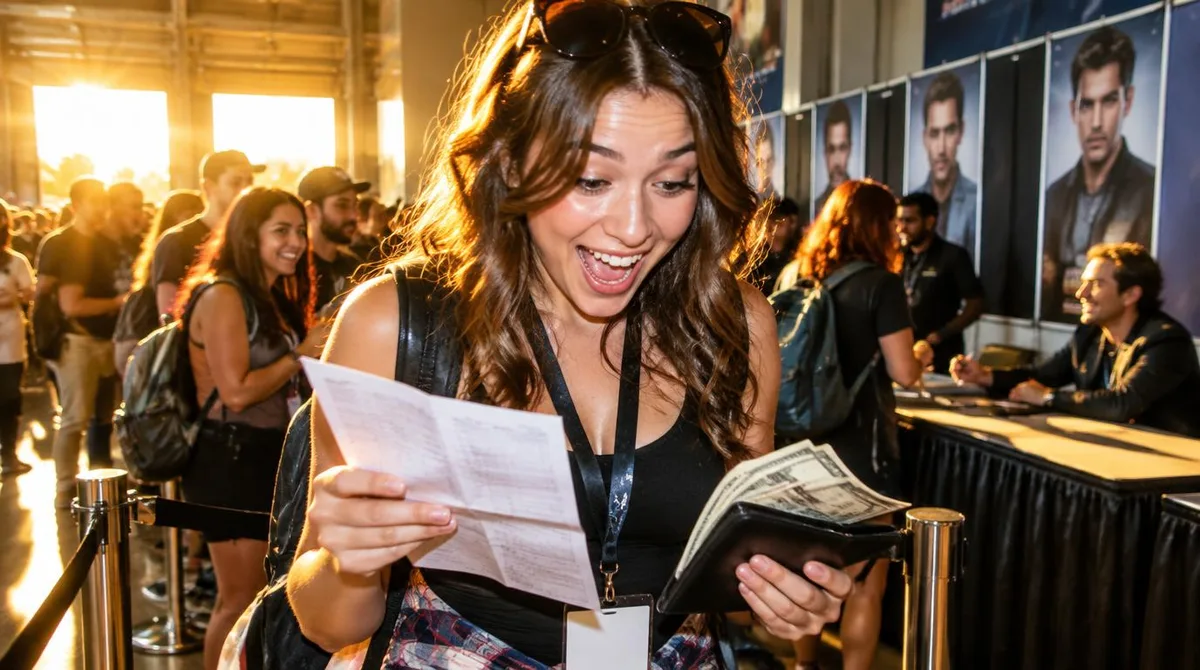
Autographs and photo opportunities are priced per guest, and the prices are set by the guests' representation, not by you. The range is enormous — a working character actor and a franchise lead are not in the same universe — so the only reliable method is to look up each guest's listed rate on the convention's own page before you go, add the print or item you will bring, and set a ceiling for the weekend. Our analysis: the regret cases are almost never the planned splurge. They are the impulse adds, bought in a queue because the moment felt scarce.
Three practical notes. First, most guests sign one item per ticket; a second item usually means a second ticket. Second, personal items — the toy you have had since childhood — are often welcome but sometimes carry a surcharge; check the rules. Third, bring cash in small notes. Tipping is customary at many tables, and card readers fail in convention-centre basements with impressive consistency.
How do you survive the lines?
Lines are the true currency of a convention. The biggest panels fill hours ahead; the popular photo sessions queue before their posted times. The mechanics are simple and worth stating plainly:
- Ask a volunteer which room the line is actually forming in — it is rarely the room on the map.
- Eat and drink before you commit. Once you are deep in a queue, leaving means losing your place.
- Carry a battery pack. A dead phone at a convention strands you from the schedule, the maps and your friends.
- Accept the trade-off: one front-row panel beats three half-seen ones.
Volunteers are the most underused resource in the building. They know which halls run cold, which toilets have no queue and when the merchant hall restocks. Ask them. It is their entire role.
What are the unwritten rules of the floor?
The etiquette is mostly one principle: the person in costume, at the table, or in the queue is working, and the person walking the floor is a guest like you. Ask before photographing a cosplayer — most say yes, and it costs nothing to ask. Never touch a costume or prop without permission; the armour took months and the glue is not decorative.
At autograph tables, keep it moving. Have the item out of its sleeve, the marker request decided, and the sentence you want to say rehearsed to one breath. The guest will match your energy. Long conversations happen at designated meet-and-greets, not while forty people wait behind you.
And the merchant hall has its own provenance question. Replicas, prints and unsigned merch sit next to genuine articles, and the difference is rarely labelled loudly. Ask what is licensed and what is fan-made; fan-made is often the more interesting purchase, but it should be sold as what it is. We have covered the same dynamic in Culture kings: how streetwear drops became global events — scarcity is a sales tool, and it works best on people who did not check first.
What does a first-timer actually need in their bag?
Pack light and pack deliberately. The consensus kit is short: water, snacks, a battery pack, cash, a small sharpener or pen for autograph items, blister plasters, and a foldable bag for what you will inevitably buy. Wear the shoes you would choose for an airport day, not a night out. Convention centres are measured in miles, whatever the brochure says.
Leave the full costume for day two if you are new. Costumes are glorious and constraining in equal measure — limited seating, limited pockets, limited patience by mid-afternoon. See the terrain first.
What this means: decide what the day is for
A convention is a machine for turning enthusiasm into queues, and it does that job extremely well. The badge, the budget and the bag are all the same decision made three times: know what you came for, and let the rest go. The fans who leave happiest did one thing fully rather than five things partly — and they asked a volunteer where the quiet toilets were.
What remains genuinely unknowable in advance is the mood of the room: which panel becomes the one people quote for months, which guest goes off-script and delights everyone. That is the part no guide can schedule. It is also the part worth the badge.